Bedroom Lighting Ideas: Layers, Warmth and Control

In this article
The best bedroom lighting is layered: a dimmable ambient source overhead, a reading light within reach of the bed, and low accent light for atmosphere, each on its own control. Keep the colour warm, around 2700K to 3000K, and the room will feel calm rather than lit.
This guide covers the layout, the heights, the colour temperatures and the controls. It also covers what to do when the room is small or the ceiling is low.
TL;DR
- Use at least two layers: overhead ambient light and bedside light. Add accent light if the room allows, and put each layer on its own switch or dimmer.
- Hang or fix reading lights so the beam falls on the page, not in your eyes. The bottom of a bedside shade sits roughly 40 to 50 cm (16 to 20 in) above the mattress.
- Choose warm white, about 2700K to 3000K, for the main bedroom light. Keep cooler light for the dressing table, if you want it at all.
- In a small room, swap bedside tables for wall lights, and use a flush ceiling fitting if the ceiling is low.
- Have a qualified electrician fit any new ceiling light or circuit.
Table of Contents
- Start with layers, not a single fitting
- Plan the layout around the bed
- Get the reading light right
- Choose the right colour temperature and brightness
- Control matters as much as the fitting
- Small rooms and low ceilings
- Match the wood to the room
- If the bedroom also holds a desk
- Lights made for your bedroom
- Safety and installation
- A worked example: a 3 m by 3.5 m bedroom
- FAQ
- Sources
Start with layers, not a single fitting
A bedroom is a place to wind down. A single bright central light works against that. Designers quoted by Homes & Gardens say bedrooms need lower ambient levels than other rooms because they are relaxation spaces. They also favour low-level and concealed light to add depth.
Three layers cover almost every room:
- Ambient light is the general glow you use to move around, dress and tidy. A ceiling fitting or pendant does this job.
- Task light is focused light for reading, dressing and applying make-up. Bedside lamps, wall lights and mirror lights belong here.
- Accent light sits lower and softer. Think of a strip behind a headboard, a glow along a shelf or a lit alcove.
Ideal Home suggests at least two layers, overhead and bedside, and says each should work independently. That independence matters more than the number of fittings. With separate switches or dimmers you can use only the layers a given moment needs: full ambient light for changing the bed, bedside light alone for reading, accent light alone for the last ten minutes before sleep.
A simple test helps. Stand in the doorway and switch on only one layer at a time. If any single layer leaves the room unusable, or glaring, the balance is off.
Plan the layout around the bed
Plan the bed first, then place the lights. Houzz UK suggests working through the room’s functional areas in turn: bedside, mirror, wardrobe and circulation.
Overhead light
Centre the main light on the ceiling. Ideal Home adds one exception: if the bed is deliberately off-centre, position the light over the bed instead. A pendant above the foot of the bed, rather than above your head, also keeps the fitting out of your line of sight when you lie back.
Bedside light
Lamps and wall lights both work. Table lamps are the easiest to move and change. Wall lights free up the surface and let you place the beam precisely. If you share the bed, give each side its own control. BBC Homes advises separate switches for built-in lights on either side of a double bed, so one person can read while the other sleeps.

Mirror and wardrobe
A dressing table needs light from both sides, not from above alone. BBC Homes recommends horizontal lighting on either side of the mirror to avoid shadows across the face. For wardrobes, Houzz UK points to integrated wardrobe lighting or downlights in front of the doors, so you can see colours properly when choosing what to wear.
Night-time movement
Houzz UK quotes a designer who recommends discreet floor-washers at or just above the skirting board. They are triggered when someone gets up at night, and they guide the way without waking anyone else. If you cannot add sensors, a low lamp on a separate dimmer, set very low, does a similar job.
Get the reading light right
The most common bedroom lighting mistake is a bedside lamp that is too low or too bright. It glares at the reader and lights the partner’s pillow.
Three numbers help:
- Height of the shade: Ideal Home quotes a designer recommending the bottom of a bedside lampshade at roughly 40 to 50 cm (16 to 20 in) above the mattress, with the switch easy to reach.
- Height of a wall-mounted reading light: Livingetc quotes a designer suggesting about 51 to 71 cm (20 to 28 in) above the top of the mattress. The fitting sits slightly offset from the headboard, so the beam falls downwards without glare.
- Distance: keep the control within arm’s reach. Livingetc also recommends directional, dimmable reading lights that can be aimed at the page, which cuts spill and glare.
Dimmable matters here. Reading needs more light than winding down, and one lamp can serve both if you can turn it down.
Bedside lamps that suit a calm room
For bedside and desk-height light, we make the Geometric Oak and Walnut table lamps with a touch dimmer, so you can set the level without reaching for a switch. The Geometric Oak and Geometric Walnut table lamps take 2 to 3 weeks to make. If the bedside is also a small reading corner, our Curved Oak Desk Lamp is touch dimmable and works on a narrow surface.
Choose the right colour temperature and brightness
Colour temperature, measured in kelvin (K), describes how warm or cool the light looks. Lower numbers look yellower and cosier. Higher numbers look whiter and bluer.
The Energy Saving Trust notes that UK homes tend to prefer about 2,800K warm white, and that yellower light is generally preferred in sleeping areas. Ideal Home recommends 2,700 to 3,200K for a cosy bedroom and 4,000 to 5,000K for daylight-like light at a dressing table. One of the designers quoted by Houzz UK goes lower still, treating 2,200K as a bedroom sweet spot and 2,700K as her upper limit.
| Area | Suggested colour temperature | Why |
|---|---|---|
| Ceiling or pendant | 2700K to 3000K | Soft, golden light that is easy to dim |
| Bedside and reading | 2700K to 3000K | Warm enough for winding down, clear enough to read |
| Accent and night light | 2200K to 2700K | Candle-like glow at low level |
| Dressing table | 4000K to 5000K | Daylight-like light for make-up and colour checks |
Our standard light colour is 3000K warm white. We can supply 4000K and 6500K on request, and 2700K or tunable white on selected designs. Because every light is made to order, you can ask for the colour that suits the room.
Brightness in lumens
Brightness is measured in lumens, not watts. The UK Government’s bulb factsheet gives the old equivalents: 470 lumens for a 40W bulb, 800 lumens for 60W, 1,050 lumens for 75W and 1,520 lumens for 100W. For a bedroom, aim for the lower end of that scale on each source and rely on the layers, rather than one strong light, to reach the level you need.

The Energy Saving Trust also advises checking the packaging for lumens, colour temperature and dimmer compatibility. That last point catches people out: a bulb that does not suit the dimmer will buzz or flicker.
Colour rendering
Colour rendering index (CRI) describes how faithfully a light shows colour. The Energy Saving Trust says a higher CRI makes colours look more vivid. In a bedroom, that affects skin tones, fabrics and the colour of the wardrobe. Our lights offer colour rendering of up to CRI 97.
Control matters as much as the fitting
A good fitting on a poor control still gives poor light. Three controls do most of the work:
- A dimmer on the main light. BBC Homes recommends this, along with a switch by the door and control from the bed.
- Control within reach of the bed. When rewiring, House & Garden recommends placing a dimmer within reach of the bed. It also reports that several designers value a 5-amp circuit, because it lets separate lamps work together from one wall dimmer.
- Independent circuits or switches for each layer, as above.
Our control options are standard on/off, a dimmable driver, remote control or Alexa Wi-Fi. A remote suits a ceiling light you do not want to wire to a bedside switch. Alexa Wi-Fi suits those who want scenes, such as a single command that dims everything to a low glow.
Small rooms and low ceilings
In a small bedroom the lighting has to save space as well as give light.
- Swap tables for wall lights. Country Living UK recommends wall-mounted or swing-arm bedside lights when the room cannot take bedside tables. It also says mirrors create depth by reflecting light.
- Use the mirror well. Homes & Gardens says a mirror opposite a window reflects daylight into a small room. A mirror beside the window spreads light across a darker or north-facing room.
- Soften the daylight. BBC Homes suggests voile or muslin curtains to diffuse harsh daylight where it dazzles.
- Add height with light. Homes & Gardens reports that concealed linear LED light washing a ceiling can create a stronger sense of height than downlights. Strip lighting around the top of the room can have a similar effect where ceiling lights are not an option.
- Free up the surface. The Independent quotes a designer recommending integrated bedside lighting to free surface space. Pendants can frame the bed, while wall lights are the more contained, adjustable option.
When the ceiling is low
A pendant that hangs into the room can feel heavy when the ceiling is low. A flush fitting with a diffused, upward-and-downward glow keeps the head height clear. Our Hexagon flush ceiling light in walnut is dimmable, and it sits close to the ceiling. Our Circlux round and SquareLUX square flush lights suit the same job, and you can see them in the ceiling lights collection.
Where you do want a pendant, such as over a high-ceilinged bedroom or a hotel suite, our pendant suspensions adjust up to 1 m (39 in) as standard and up to 2 m (79 in) on request.
Match the wood to the room
Warm light and warm timber work together. Oak, walnut and beech each change the glow of a fitting, and each looks different beside your bed, wardrobe and floor. Our woods are solid oak, walnut and beech on most designs, and iroko on selected pieces, all finished by hand with Danish oil.
Wood on a screen never matches wood in the room. Our wood samples cost £29.99 with free UK delivery, and the cost is refunded when you order a light. You hold the sample against your bed frame or bedside table and judge it in your own daylight.
If you want a fitting to match existing furniture, we can match it from an offcut or a photo. Send the image through our bespoke lights page and we will talk it through with you.
If the bedroom also holds a desk
Many bedrooms now carry a small desk. Treat that corner as its own task zone, with a focused, dimmable light and a warmer ambient layer behind it, so the room still reads as a bedroom in the evening. A clear plan for setting up a workspace helps you decide where the desk, chair and light should sit, so the layers do not fight each other.
Our view: light the evening, not the room
We design lighting as an engineer would and finish it as a maker would. Our team brings more than 25 years in technical lighting, lighting control and product development, and that shapes how we think about bedrooms.
A bedroom is used mostly in the evening and at night. Light levels should follow what you are doing, falling gently as the day ends. That is why we build dimming into the design from the start, rather than treating it as an extra. A lamp that cannot go low is the wrong lamp for a bedside.
We also think warm light and natural timber belong together. Hand-finished oak or walnut with a 3000K glow gives a calm, candle-like quality, and CRI of up to 97 keeps fabrics and skin tones true. Every light is made to order in our UK workshop, so size, wood, colour temperature and control can be set for your room rather than compromised.
Our rating is 4.97 out of 5 from 212 reviews on our Etsy shop. We take that as a sign that the care in the making is noticed.
IVYLUX
Lights made for your bedroom
Every IVYLUX light is made to order in our UK workshop and takes 4 to 6 weeks to make. UK delivery is free. You choose the wood, the size, the colour temperature and the control, whether that is a dimmable driver, a remote or Alexa Wi-Fi.

Browse the ceiling lights and table lamps, or send us your room details on the bespoke lights page. If you are an interior designer, architect, builder or hospitality buyer, you can apply for a trade account. For a hotel or guest room scheme, send us your drawings and we will work from them.
Safety and installation
Switch the circuit off at the consumer unit before touching any fitting, and have a qualified electrician install new ceiling lights. We recommend this for every IVYLUX ceiling light.
New circuits are a regulated matter. The Welsh Government’s Part P guidance explains that electrical installations should be designed and installed to protect people from fire and injury. It also says they should be inspected and tested, and compliance can generally be shown with a BS 7671 certificate. That guidance applies in Wales. Rules in England, Scotland and Northern Ireland differ, so ask your electrician which apply to you.
Standard IVYLUX lights are rated IP20, for dry indoor rooms. That suits bedrooms. Bathroom and en-suite fittings need a higher rating, and IP44 versions are made only on request. Our LEDs are rated for 50,000 hours, and our warranty is 3 years on manufacturing defects, counted from the day the light arrives.
A worked example: a 3 m by 3.5 m bedroom
To pull this together, take a double bedroom of about 3 m by 3.5 m with a standard ceiling and a bed against the longer wall.
- Ambient: one dimmable ceiling fitting at the centre, warm white at 3000K, on a wall dimmer by the door.
- Task: a lamp or wall light on each side of the bed, each with its own control and the shade bottom roughly 40 to 50 cm (16 to 20 in) above the mattress.
- Accent: a low warm glow behind the headboard or along a shelf, at 2700K or lower, switched separately.
- Night path: a low-level light near the floor on a sensor, or a dimmed lamp on its lowest setting.
- Mirror or wardrobe: if you dress here, add light on both sides of the mirror or in front of the wardrobe doors.
That is five sources, but only three or four controls, and nothing in the room is harsh. You can run the whole scheme from a bed-side remote or voice control if you choose Alexa Wi-Fi.
FAQ
What is the best lighting for a bedroom?
A layered scheme is best: dimmable overhead light, a reading light at each side of the bed and softer accent light. Keep the colour warm, around 2700K to 3000K, and put each layer on its own control.
How high should bedside lights be?
For a table lamp, the bottom of the shade should sit roughly 40 to 50 cm (16 to 20 in) above the mattress. For a wall-mounted reading light, designers suggest about 51 to 71 cm (20 to 28 in) above the mattress, slightly offset from the headboard.
What colour temperature is best for a bedroom?
Warm white, between 2700K and 3000K, suits most bedrooms. Use a cooler 4000K to 5000K only for a dressing table where you want daylight-like light for make-up.
How can I improve lighting in a small bedroom?
Replace bedside tables with wall lights, hang a mirror where it catches daylight, and use a flush ceiling fitting if the ceiling is low. Soft voile curtains diffuse harsh daylight, and a concealed strip light can make the ceiling feel higher.
Do I need an electrician to fit a new bedroom ceiling light?
We recommend a qualified electrician for every IVYLUX ceiling light. They can also advise on new circuits, dimmer compatibility and the rules that apply in your part of the UK.
Sources
- An Expert Guide to Lighting a Bedroom, Houzz UK
- How design experts plan bedroom lighting, Ideal Home
- How to layer lighting, Homes & Gardens
- Bedroom schemes, BBC Homes
- Read in bed? What to know about bedroom lighting, Livingetc
- 23 illuminating bedroom lighting ideas, House & Garden
- Let the light shine in with energy efficient lighting, Energy Saving Trust
- UK Government bulb factsheet
- How to make a small bedroom feel bigger, Country Living UK
- Best furniture for small bedrooms, The Independent
- Where to hang a mirror in a small bedroom, Homes & Gardens
- Building regulations guidance Part P, Welsh Government
Recommended
The lights in this article.
See every light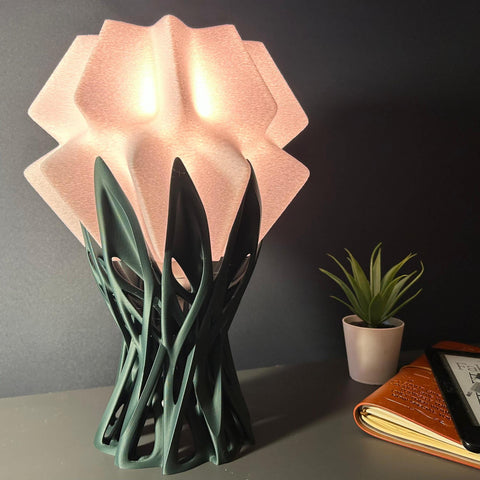 Minimalistische Tischlampe: Umweltfreundliche Nachttischleuchte
£39.99
Shop Minimalistische Tischlampe: Umweltfreundliche
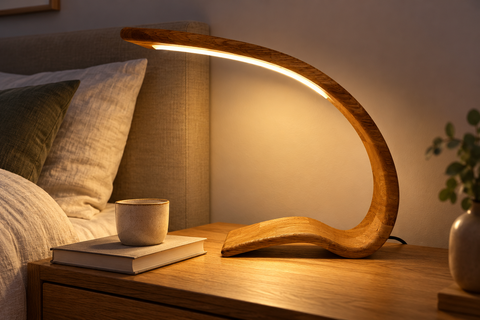 LED-Schreibtischlampe aus Eichenholz: Moderne Nachttisch-Leselampe mit…
from £174
Shop LED-Schreibtischlampe aus Eichenholz:
 Hexagon
from £265
Shop Hexagon
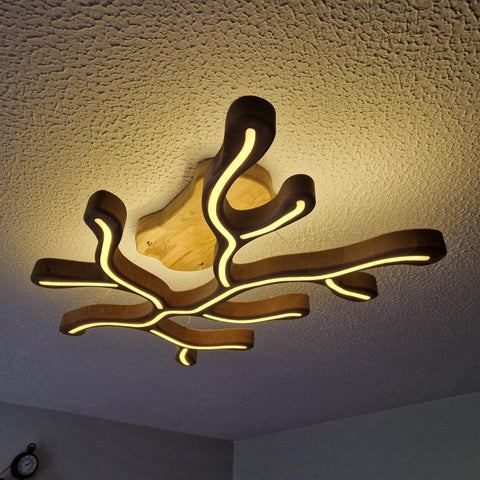 Deckenleuchte Holz LED, Direkt Indirekt Deckenleuchte…
from £395
Shop Deckenleuchte Holz LED,
?Planning a room
Tell us about the room. We will help you choose.
Send the room size, the ceiling height and a photo if you have one. We can suggest a size and colour of light, or draw a bespoke piece.

