Sloped Ceiling Lighting: What Works and How to Hang It

In this article
The most reliable way to light a sloped ceiling is to let the light hang or stand where gravity and the room want it: pendants on an angled canopy, wall lights, floor and table lamps, and flush fittings only where the surface is level or has a levelled mounting pad. Whatever you choose, have a qualified electrician fit it, because a slope changes where cables, insulation and fixings sit.
A pitched ceiling is a gift for a lighting designer. It gives you height, an angled surface to bounce light from, and often a beam or ridge to hang from. It also removes the neat, flat plane that most fittings assume. This guide sets out what works, what to check first, and how to plan layers of light so the room feels calm at night.
TL;DR
- Pendants suit sloped ceilings best, because they hang vertically whatever the angle above. Use an angled canopy or a ridge beam fixing.
- Flush fittings need a level seat. On a slope, that means a mounting pad or a ceiling that is only gently pitched.
- Add wall, floor and table light so the ceiling is not doing all the work. Aim for 3000K warm white, dimmable.
- Check cable routes, insulation and fire rating before you choose recessed downlights in a sloping ceiling.
- Always use a qualified electrician to install ceiling lights.
Start with the slope itself
Before you look at a single fitting, take four measurements and one photograph.
- The pitch. Hold a spirit level against the ceiling and measure the drop over 100 cm (39 in). A gentle slope behaves almost like a flat ceiling. A steep one, such as an attic room, does not.
- The lowest and highest points. Note the height from floor to ceiling at the eaves and at the ridge, in cm.
- Where people stand and sit. Mark the walkways, the bed, the desk and the dining table on a sketch.
- What is behind the plasterboard. Joists, rafters, battens and insulation decide where a fixing can go.
The photograph matters if you plan to commission something made. A picture of the whole room, taken from the doorway, tells us more than a list of numbers. If you want a light made to your own dimensions, you can send drawings and photographs through our bespoke lights page.
The types of light that work on a sloped ceiling
Pendants on an angled canopy
A pendant hangs straight down. The slope only matters at the top, where the canopy meets the ceiling. A flat canopy on an angled surface sits with a visible gap on one side and strains the fixing. An angled or swivel canopy adapter lets the fitting sit flush against the pitch while the suspension drops true. Your electrician can specify one to suit the fitting and the ceiling material.
Two practical points:
- Hang the pendant from the highest sensible point, not the middle of the slope. Near the ridge you gain headroom, and the light reaches more of the room.
- Keep the lowest edge clear of heads. In a walkway, we suggest the underside of a pendant sits no lower than 200 cm (79 in) from the floor. Over a table, the usual range is 70 to 80 cm (28 to 31 in) above the tabletop.
IVYLUX pendant suspensions adjust up to 100 cm (39 in) as standard, and up to 200 cm (79 in) on request. That second figure is useful when a ridge is high and the table sits well below it.
Hanging from a beam or from the wall
If the roof has exposed beams, the cleanest solution is often to hang from the beam rather than the sloped surface. A designer featured by Houzz UK hung pendants from the wall and hooked them to the centre of beams in a dining room with a glazed roof, so the lights added interest without blocking daylight or sightlines. The same thinking works in a loft conversion: let the structure carry the weight and keep the fitting out of the view line.
A beam fixing should be made into the timber itself, never into plasterboard alone. Ask your electrician and, where the beam is structural, a builder, to confirm what it will carry.
Flush and semi-flush fittings
A flush ceiling light is a good answer to a low edge of a sloped ceiling, where there is no room for a drop. The difficulty is the back plate. It is flat. The ceiling is not.
There are two sensible routes:
- A gently pitched ceiling. The gap behind a compact fitting may be small enough to close with a shallow, painted timber pad cut to the angle.
- A levelled pad on a steeper slope. A timber backing block, cut so its face is horizontal, gives the fitting a true seat. It can be painted to match the ceiling.
For low areas we make the Circlux round, Hexagon and SquareLUX square flush ceiling lights. The round oak and walnut ceiling light and the solid oak square ceiling light are both made in our UK workshop and finished by hand with Danish oil. Any ceiling light, on a slope or not, should be installed by a qualified electrician.
If your slope is steep and none of the standard sizes suits, tell us. Custom sizes are part of what we do, and a drawing is the quickest way to start.
Recessed downlights: check before you cut
Downlights seem tidy on a sloped ceiling, but this is where the building rules bite. The LABC guide to downlighters says that halogen downlights can generate significant heat, and that this may rule them out in sloping ceilings where adequate clearance cannot be achieved without unacceptable cold bridging. It adds that LED or CFL lamps may allow a compliant arrangement.
The same guide gives spacing rules for downlighters in separating floor constructions: a minimum ceiling void of 75 mm, no more than one light per 2 m², centres at least 750 mm apart and lining openings no larger than 100 mm. Those figures apply to a specific construction, so your electrician or building control officer should confirm what applies to your roof.

In a sloping ceiling the void is often shallow and packed with insulation. That is a reason to plan any recessed lighting with your electrician before you buy.
Wall lights, floor lamps and table lamps
The sloped ceiling’s biggest advantage is the vertical wall space below it, and the least used. Wall lights on the upright sections, floor lamps tucked into the angle and table lamps on a sideboard all avoid the ceiling entirely. They also bring the light to eye level, which is where a room feels cosy rather than bright.
A floor lamp can face upwards into the slope, using the angled surface as a soft reflector. Warm, indirect light on a pitched ceiling gives a gentle wash that flat ceilings rarely manage.
Plan the layers of light
A room with a slope is usually one with a mix of jobs: sleeping, reading, working, eating. One central fitting will not serve all of them. Think in three layers.
| Layer | Job | Typical choice on a slope |
|---|---|---|
| Ambient | General glow | Pendant near the ridge, or flush light at the low edge |
| Task | Reading, desk, cooking | Table lamp, wall light, pendant over a table |
| Accent | Mood, texture | Floor lamp uplighting the slope |
Put each layer on its own control where you can. A dimmable driver, remote control or Alexa Wi-Fi control is available on IVYLUX lights, along with standard on/off. Our table lamps use a touch dimmer.
Rooms where a slope appears
Loft bedroom
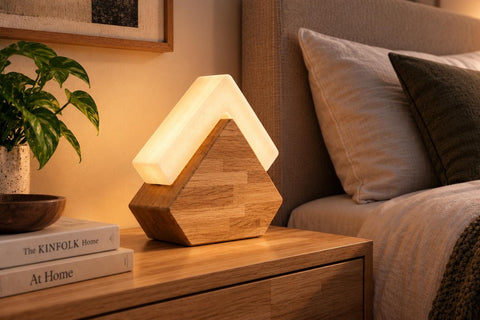
The bed often sits under the lowest part of the slope. Avoid a pendant above it. Use wall lights or table lamps either side, and a flush fitting where there is headroom. For bedside and desk work, our Geometric Oak or Walnut Table Lamp, or the Curved Oak Desk Lamp, give a focused pool of light. See our table lamps.
Open-plan kitchen and dining under a pitched roof
Here a linear pendant follows the line of the table, and the ridge gives you the drop. Our Oak Linear Pendant is one option for tables and islands, and we have written about how to light a dining table well in more detail, and about where every light goes in a kitchen lighting layout.

Living room with a vaulted ceiling
A tall room can carry a large pendant. Scale matters: a fitting that looks generous in a shop can look small in a high space. Our guide to oversized pendant lighting covers sizing and hanging height.
Hallway and landing
The slope often follows a staircase. Keep fittings clear of the head line and use a flush light at the low point.
Bathrooms and damp rooms
Standard IVYLUX lights are rated IP20 for dry indoor rooms and are not intended for bathrooms. IP44 versions for damp areas are made only on request, so ask before you order.
Colour temperature and quality of light
A sloped ceiling is often painted white, and white surfaces make light feel colder than it is. A warmer lamp balances that.
- 2700K to 3000K for bedrooms, living rooms and dining. This is the golden-yellow glow reminiscent of candlelight.
- 4000K for a workspace or a kitchen where you want a clearer, more neutral white.
- 6500K is cool daylight white and best kept for specialist work areas.
The standard IVYLUX colour is 3000K warm white. 4000K and 6500K are available on request, and 2700K or tunable white on selected designs. Colour rendering is how truthfully a light shows colours, and our lights offer up to CRI 97. That matters on timber, fabrics and skin tones. Our LEDs are rated for 50,000 hours.
If you plan to match light to furniture, wood tone counts as much as colour temperature. Oak, walnut and beech read differently under warm light. Our wood samples cost £29.99 with free UK delivery, and the cost is refunded when you order a light. You can order wood samples to hold against your floor and furniture. We can also match a wood tone from an offcut or a photo of your furniture.
Safety and building rules on a slope
This is the part of the job where a quick fix costs the most later.
Cables behind sloping surfaces. NHBC technical guidance says that where cables run behind a surface that could be a wall or a ceiling, they should be protected as for walls and ceilings, with cables at least 50 mm from the top or bottom of the ceiling support, such as a joist or batten. Drilling for a fixing without knowing where cables run is a real hazard on a slope.
Notifiable work. NICEIC explains that installing a new domestic lighting circuit, or working in special locations, is notifiable under Part P of the Building Regulations in England and Wales. It must be notified to Local Authority Building Control or carried out by an electrician on a competent person scheme. NICEIC also strongly advises using a qualified electrician for any new lighting installation.
Insulation. Loft conversions are insulated tightly. Anything recessed needs the right fire and heat rating, and your electrician should check this against the roof construction.
Earth. A metal canopy adapter or a metal fitting must be earthed correctly. This is one more reason the work belongs to a qualified electrician.
Planning the order of work
- Measure the slope and sketch the furniture.
- Decide the layers: ambient, task, accent.
- Choose the fixing points with your electrician, near the ridge or on beams where possible.
- Choose fittings and controls to suit, and confirm the canopy type for the pitch.
- Order. All IVYLUX lights are made to order in our UK workshop and take 4 to 6 weeks to make. The Geometric Oak and Geometric Walnut table lamps take 2 to 3 weeks.
- Fit the lights once plastering and decorating are finished.
Because lead times are weeks, order the lights before the electrician’s first fix is complete, so the cable positions match the fittings.
Our view as makers
Sloped ceilings reward patience. The room already has a shape, and the best lighting follows it rather than fighting it.
We design our lights with an engineering mind. More than 25 years in technical lighting, lighting control and product development sit behind the work of the IVYLUX Team. That means we think about the angle of a canopy, the heat of a driver and the quality of the light as much as the grain of the oak.
Solid wood suits a pitched roof. It has weight and warmth, and it looks at home against exposed timber and white plaster. Each light is made to order and finished by hand with Danish oil, so size, wood and controls can be fitted to your room rather than the other way round.
When a slope is awkward, send us the drawing. A good fitting often starts as a conversation about one angle.
IVYLUX
Lights made for your roof line
If you want a fitting made to suit a sloped ceiling, we make ceiling lights, table lamps and floor lamps to order, with your choice of wood, size, colour temperature and controls. Browse our ceiling lights, or send a drawing and photographs through our bespoke lights service. UK delivery is free on every IVYLUX light.

Interior designers, architects, builders and hospitality buyers can apply for a trade account. For hotels, restaurants, cafés and offices with pitched roofs, the quickest route is to send your drawings through the bespoke page, so we can look at the geometry together.
Warranty and returns
Our warranty is 3 years on manufacturing defects, counted from the day the light arrives. Standard lights can be returned within 30 days of delivery, with return postage paid by the customer. Lights made to your own specification, such as a custom size, wood, finish or design, cannot be returned for a change of mind, so measure carefully and use wood samples first. Our rating is 4.97 out of 5 from 212 reviews on our Etsy shop.
FAQ
What are the best lights for a sloped ceiling?
Pendants are the most dependable, because they hang vertically whatever the pitch, with an angled canopy at the top. Add wall lights and table or floor lamps for task and mood light. Flush fittings work at the low edge if they have a level seat.
How do you mount a light on a sloped ceiling?
Use an angled or swivel canopy adapter for a pendant, or a levelled timber pad behind a flush fitting. Fix into rafters or beams, not plasterboard alone. Have a qualified electrician do the installation and check cable routes first.
Can you fit downlights in a sloping ceiling?
Sometimes. Heat and clearance are the limits, and LED lamps may allow a compliant arrangement where halogen would not. Ask your electrician or building control to confirm the insulation, fire rating and void depth for your roof.
What colour temperature suits a sloped ceiling?
Warm white, 2700K to 3000K, suits most living and sleeping rooms and balances white ceilings that can feel cold. Use 4000K only where you need a clearer light for work. Fit a dimmable driver so you can lower the level in the evening.
Sources
- How to Hang Pendant Lights from a Sloping, Glazed or Open Ceiling, Houzz UK
- LABC Guide to the safe installation of downlighters in dwellings
- Light fitting installation, replacement and repair, NICEIC
Recommended


?Planning a room
Tell us about the room. We will help you choose.
Send the room size, the ceiling height and a photo if you have one. We can suggest a size and colour of light, or draw a bespoke piece.

